
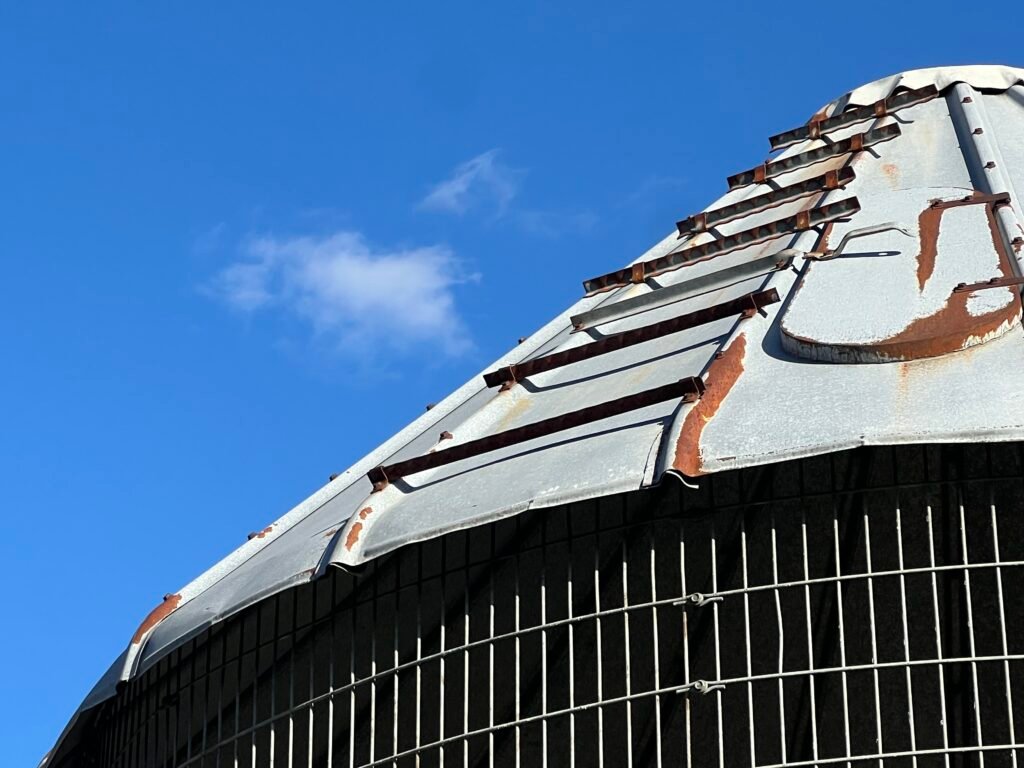
Art. Story. Memory. Light.
Kari McCarren Hazzard · Artist · Author · Archivist
I Grew Up Making Things
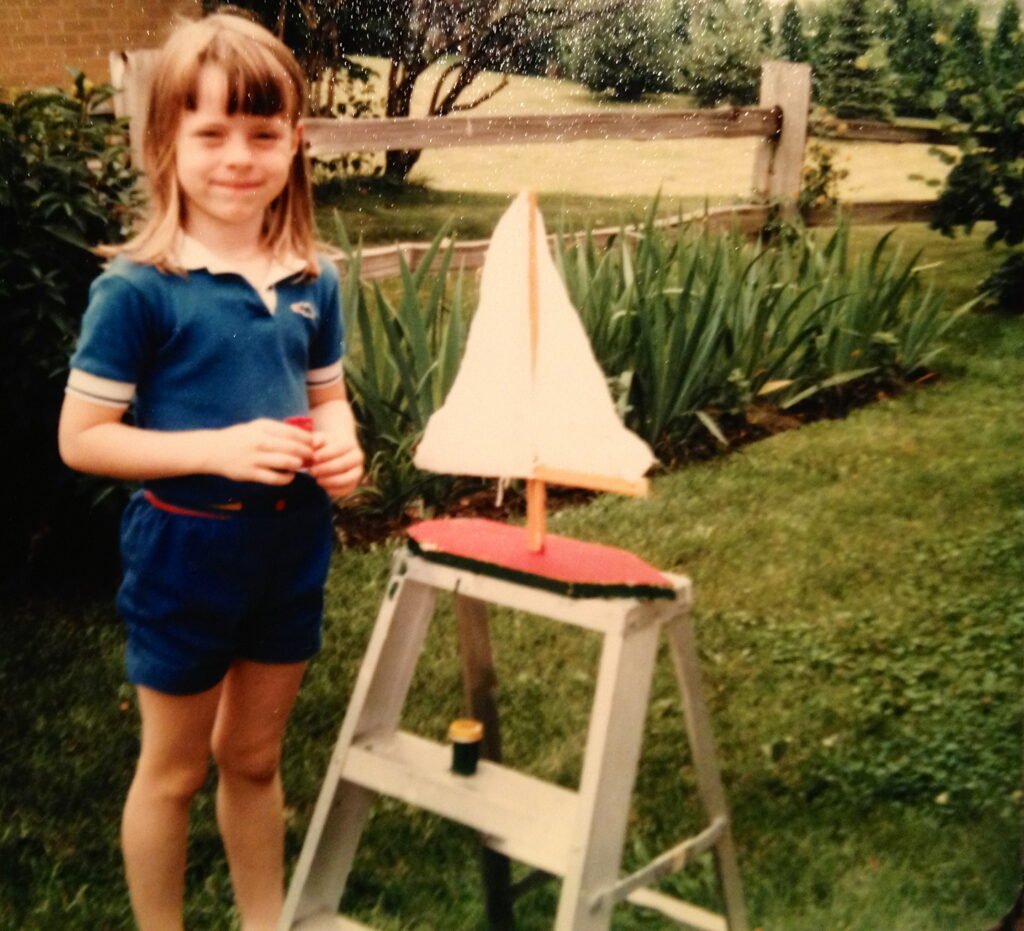
I have been making things for as long as I can remember.
Some of the earliest pieces still survive: greeting cards I made for my family as a child and that eventually found their way back to me, a kindergarten drawing of Jesus, and a little book I wrote in second grade called The Octopus and the Sea Garden.
Looking back, I can already see the things that would follow me through my life: pictures and words, faith and imagination, curiosity, and an instinct to preserve what mattered.
I also grew up inside a family business.
My brother and I were immersed in it early, working trade shows at McCormick Place in business clothes while we were still kids, learning to talk to strangers, shake hands, represent the company, and watch ideas become tangible things. My father could sketch an idea on a yellow legal pad with a blue Bic pen, take it into the shop, experiment with it, change it, and eventually turn it into something real.
But my father was something else, too.
He was an extraordinary watercolor artist.
And in some ways, I followed his example there as closely as I followed his example in business. He rarely shared his artwork publicly. He gave paintings to people he loved. Art was personal, something precious enough to give away but not necessarily something to place before the world. It wasn’t until he was in his sixties, within a few years of being diagnosed with cancer, that he participated in an art show and sold his work.
For most of my life, I treated my own creativity much the same way.
Art was never an afterthought.
It was simply private.
At Boylan Catholic High School, with its strong fine arts tradition, I became an honors art student and participated in the senior art show. At the same time, I was deeply drawn to literature and language. I worked on the yearbook, eventually became one of its editors, and graduated with an unusually heavy concentration of English coursework.
I was also already inclined to wander beyond the expected boundaries.
In religion class, I frequently wrote essays about controversial, outlier ideas such as consciousness, past lives, and moral sacrifice, fairly unconventional subjects for a Catholic-school student. Brother George, a Franciscan friar who taught me, allowed me to investigate these questions seriously rather than shutting down my inquisitiveness.
That permission to follow an idea wherever it led has stayed with me since.
But permission, I would eventually discover, was something I was much better at accepting from other people than giving to myself.
Before Rockford College, there had actually been another plan.
I wanted to go to the School of the Art Institute of Chicago.
I was paying for my own education, so technically there was nothing stopping me. But a family member, not my dad, made it emphatically clear that they thought I was basically a lunatic for even considering it.
And I listened.
That’s the part that makes me sad now.
Not because I spend my life wondering what would have happened if I’d gone to art school, but because I can see now how readily my younger self surrendered her own authority when someone she trusted spoke with enough certainty.
I knew what I wanted.
I just didn’t yet know that I was allowed to trust myself enough to defend it.
So the Art Institute disappeared from the plan.
By the time I entered Rockford College in 1994, I wasn’t thinking about studying business or becoming a professional artist whatsoever.
I wanted to write.
A family trip to the Washington, D.C. area just before my freshman year of high school had left an enormous impression on me. My great-aunt Maddy and uncle Joe lived in Bryans Road, Maryland, and this lifelong history hound became fascinated by the possibility of combining writing with political science, perhaps becoming a journalist and someday making my way back to Washington.
The Art Institute may have disappeared from the plan, but at least I still had that dream.
I could write.
I could become a journalist.
I still had somewhere to hang my hat.
Banking, meanwhile, was supposed to be the practical part.
I had started as a teller at Amcore Bank immediately after high school. It was good work and good money for a college student, but I didn’t imagine it as my creative identity or even necessarily as my eventual career.
Then life began rearranging the map.
An early and inappropriately harsh criticism by a college literature professor caused me to walk away from writing almost immediately.
Looking back, I can see the pattern now.
Once again, someone I perceived as having authority spoke with enough certainty, and I surrendered my own.
I wish I could say I completely outgrew that tendency. I’m not sure I have. What has changed is that I can see it now.
And back then, I couldn’t.
So I continued moving forward professionally instead.
Banking became a career. Entrepreneurship followed. Then Human Resources and employee development. I kept being given greater responsibility and discovering abilities I hadn’t necessarily set out looking for.
And through all of it, I kept making art.
I simply didn’t think of the two worlds as belonging together.
Business was something I did professionally. Art was something I did because I loved it privately. Writing became something I had once intended to do.
Then came marriage, motherhood, leaving the conventional career path, returning to college, finishing my degree, training as a coach, consulting, and meeting people from all over the world.
Life kept giving me material even when I didn’t realize I was collecting it.
For a long time, I think I assumed a life was supposed to make more sense than mine did.
One thing was supposed to lead neatly to the next. You chose a direction, became something, and then presumably remained that thing.
Mine didn’t work that way.
It wandered.
It doubled back.
It took long detours through places I never expected to go.
Some doors I chose. Some opened unexpectedly. Some I allowed other people to close for me. And some, many years later, I found myself standing in front of again.
The first real crack in the wall between my private creative life and the outside world came almost by accident.
On a whim, I entered a juried art show at Rockford’s Nicholas Conservatory in February 2016. My painting was the only piece in the show that sold, and it sold right off the gallery wall because the buyer wanted it so badly.
What stayed with me even more than the sale was the woman who bought it.
She was ecstatic about the work.
It made me wonder whether I had misunderstood something.
Perhaps keeping art close wasn’t the same thing as honoring it.
Perhaps sharing it mattered, too.
Still, it took time.
And then I moved to Lena.
Something here became a fiery catalyst.
I don’t know how to define it more precisely than that. I know creatives, artists, and authors alike often say that certain places bring out their best work.
I would definitely say Lena is that place for me.
Something caught, and once it did, the boundaries I had maintained for most of my life began burning away.
The visual work opened first.
Then the writing.
Then the things I had kept much closer to the heart: my thoughts about God and faith, spirituality, history, human connection, memory, and the strange threads that seem to run between people and across generations.
Things I had kept in separate rooms for decades began finding one another.
And somewhere in that process, I recognized someone I hadn’t realized I’d been missing.
My five-year-old self.
The child who made things simply because making them seemed natural. Who drew Jesus and wrote little books and followed interesting questions without first asking whether they were practical, marketable, respectable, or easily explained.
There is a peculiar circularity to discovering that at fifty.
In some ways, I feel more like that child now than I did at twenty, thirty, or forty.
Not because the intervening years disappeared, but because something about this chapter of my life has allowed all those accumulated selves to come home to one another.
And perhaps that is what I wish I had understood much earlier:
A life does not have to follow a straight line to be going somewhere.
The detours count.
The practical jobs count.
The abandoned plans count.
The things you put down for twenty or thirty years and unexpectedly pick up again count.
Even the roads you took because you hadn’t yet learned how to say no, this is my life and I get to decide become part of the terrain.
I don’t wish those years away.
They gave me people, stories, skills, experience, failures, questions, memories, and an entire vocabulary for understanding the world that the eighteen-year-old who wanted to go to art school simply didn’t have yet.
The books I love make pictures in my mind. Music does it too. A phrase can become color and texture. A building can become a painting. A photograph taken simply because I don’t want to forget something can become a work of its own. History becomes story. Memory becomes archive. Faith wanders through all of it.
One of my large abstract works grew from Gordon Lightfoot’s If You Could Read My Mind, becoming an exploration of connection, memory, past lives, soul journeys, and the strange ways human lives seem to cross and recross one another.
That is how much of my work begins.
I am fascinated by the tapestry of a life: color and texture, memory and nostalgia, history and story, the bardic and the Celtic, the mystical and magical, the Catholic and sacred.
Threads that may appear unrelated until enough of the tapestry exists to see that they belonged together all along.
Photography entered my practice almost incidentally. I began photographing things as a way of archiving them: a building, a landscape, a particular quality of light, something I might want to return to later.
Eventually I realized those photographs carried their own atmosphere.
For most of my life, I thought all these parts of myself needed separate rooms.
I don’t anymore.
The girl making art and writing unusual papers in Catholic school, the kid working trade shows, the young teller, the would-be journalist, the entrepreneur, the HR director, the coach, the mother, the history hound, the artist, the writer, the archivist: she was always the same person.
I just couldn’t see the whole pattern yet.
Now I can.
I write visually. I paint narratively. I photograph as a way of remembering. I archive because I don’t want meaningful things to disappear. And I write about faith, mystery, history, and human connection because those things belong to my creative life every bit as much as pigment and paper do.
At fifty, I find myself less interested in keeping any of it hidden.
And perhaps there is some permission in that for someone else, too.
You don’t have to have figured yourself out at eighteen.
You don’t have to explain why the thing you do now doesn’t look anything like the thing you did ten years ago.
You are allowed to change direction.
You are allowed to return to something you once abandoned.
You are allowed to discover that the thing everyone else considered a detour was actually carrying you somewhere important.
And you are allowed, at any age, to reclaim authority over your own life and decide where the road goes next.
The fire didn’t burn those earlier lives down.
It illuminated the way they had always belonged together.
Perhaps that is why I have never been particularly good at putting my work into a box.
A tapestry isn’t meant to be put in a box.
It’s meant to be unfolded, hung, and seen.
The Creative Practice
A Life Made by Hand
My creative practice has never belonged to a single medium. I work in watercolor, illustration, pencil, acrylic, large-scale abstract painting, metalwork, pottery, sculpture, photography, and words. Sometimes a place begins a painting. Sometimes a phrase from a song becomes color and texture. Sometimes a photograph taken simply to remember something becomes a work of its own. What connects it all is an attraction to atmosphere, story, and the traces people and places leave behind. I am drawn to old buildings and sacred spaces, landscape and light, history and memory, faith and mystery, and the ordinary things that somehow carry more meaning than they ought to.

STAY AWHILE
There’s More to Explore!
This is one roof for all of my creative work: art, writing, photography, history, and the occasional rabbit hole. Have a look around you might never know what you find.
